
Views: 0 Author: Site Editor Publish Time: 2026-09-22 Origin: Site


The exponential scaling of commercial and utility-scale solar photovoltaic (PV) systems has elevated the critical need for precise, failure-proof overcurrent protection. Specifying the wrong type of circuit protection—specifically, misapplying alternating current (AC) components in direct current (DC) applications—is a primary cause of catastrophic arc flashes, equipment fires, and system downtime in solar installations. Field technicians frequently encounter melted combiner boxes resulting from this exact engineering oversight. Direct current behaves fundamentally differently than alternating current under fault conditions, lacking the natural zero-crossing that AC relies on to extinguish electrical arcs.
To ensure system longevity, safety, and code compliance, engineers and system designers must understand the distinct physical mechanics, evaluation criteria, and deployment zones when choosing an AC vs DC Molded Case Circuit Breake for solar energy architectures. Proper component selection directly impacts the operational safety of the entire array. You cannot rely on legacy electrical practices when dealing with high-voltage solar strings. We will examine the core engineering principles that separate these devices, how to evaluate their specifications, and where to deploy them effectively across your single-line diagram.
Physics Dictate Design: AC breakers rely on natural zero-crossing points to extinguish arcs, whereas DC breakers require specialized magnetic blowouts, elongated arc chutes, and series-wired poles to force arc extinction.
Strict Non-Interchangeability: Never use a standard AC MCCB in a DC solar circuit; doing so guarantees failure under fault conditions due to sustained arcing.
Strategic Placement: DC Molded Case Circuit Breakers protect the PV strings, combiner boxes, and battery storage, while AC MCCBs protect the inverter output and grid interconnection.
Regulatory Compliance: Component selection must strictly adhere to PV-specific standards, notably UL 489B and IEC 60947-2, to ensure safe operation under extreme environmental and electrical stresses.
Table of Contents
Circuit breakers protect electrical systems by interrupting dangerous fault currents. When contacts open during a short circuit, an electrical arc forms between them. The breaker must quickly control and extinguish this arc to safely isolate the fault. The design of the arc control system depends on whether the circuit uses AC or DC power.
AC breakers benefit from the natural zero-crossing point of alternating current. When the current reaches zero, the arc loses its energy source and becomes easier to extinguish. The breaker only needs to cool and stretch the arc enough to prevent it from restarting when voltage returns.
DC circuits do not have a natural zero-crossing, so the arc continues to burn after the contacts separate. Standard AC breakers cannot safely interrupt high-voltage DC because the arc may damage contacts and internal components. DC breakers require special designs, such as stronger arc chambers and magnetic blowout systems, to safely stop continuous current flow.
Safely interrupting high-voltage DC solar currents requires aggressive internal engineering. A DC Molded Case Circuit Breaker does not wait for a zero-crossing that will never arrive. It actively attacks the arc. Manufacturers utilize specific mechanical and magnetic technologies to stretch, cool, and suffocate the plasma until the voltage required to sustain the arc exceeds the available system voltage. The internal architecture of these devices reflects the severe demands of continuous direct current.

DC breakers use advanced arc control technology to safely interrupt high-voltage current. Magnetic blowout systems push the arc away from the contacts and into the arc chute, where metal plates split and cool the arc until it disappears. This process prevents contact damage and allows the breaker to safely isolate the circuit.
High-voltage solar systems often use multiple breaker poles connected in series to improve arc interruption capability. When the breaker opens, each pole shares the electrical stress and creates additional isolation gaps. This design allows DC breakers to safely handle 1000Vdc and 1500Vdc applications.
Fast fault response is critical for DC protection. DC breakers use high-speed spring mechanisms to quickly separate contacts and reduce arc duration. Durable contact materials, such as silver-tungsten alloys, help prevent overheating, welding, and long-term damage during repeated fault interruptions.
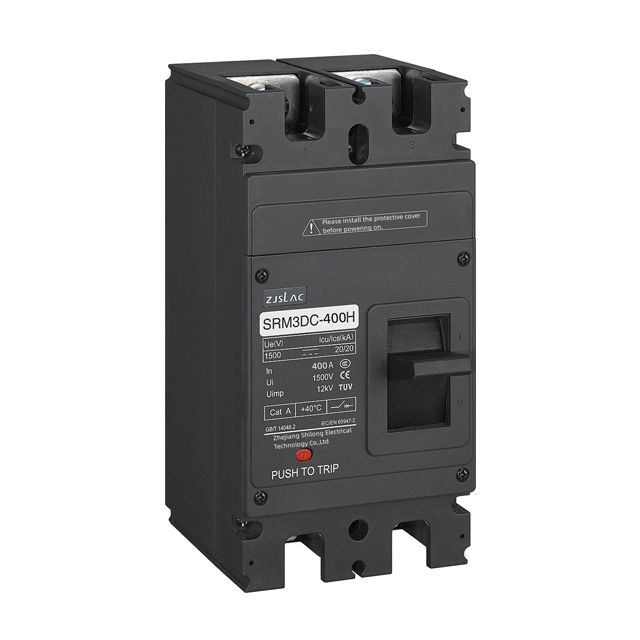
Selecting a DC breaker requires matching the device specifications with the solar system requirements. Engineers should carefully evaluate voltage rating, breaking capacity, and trip technology to ensure safe and reliable protection.
DC breakers for solar systems must match the maximum voltage and current generated by the PV array. Engineers need to calculate the highest possible string voltage under low-temperature conditions and select a breaker with a rating above this value. Proper sizing prevents insulation failure and improves system safety.
Breaking capacity defines the maximum fault current a breaker can safely interrupt. Important values include Icu and Ics, which indicate the breaker’s ability to handle fault conditions and continue operating. The selected breaker must match the available fault current of the PV system or power source.
DC breakers commonly use thermal-magnetic trip units for reliable overload and short-circuit protection. Thermal protection handles long-term overloads, while magnetic protection responds to sudden faults. Electronic trip units offer more adjustment and monitoring features but are less common for direct PV DC applications.
The grounding design of a solar system affects breaker selection. Grounded systems usually interrupt only ungrounded conductors, while floating systems require breakers that can disconnect both positive and negative conductors for complete isolation and safe fault protection.
The current flow direction determines the correct breaker type. PV systems usually use directional breakers because current flows from panels to inverters. Battery storage systems require bi-directional breakers because current can flow during both charging and discharging operations.
Evaluation Dimension | DC Molded Case Circuit Breaker | AC Molded Case Circuit Breaker |
|---|---|---|
Arc Extinction Method | Magnetic blowouts and elongated arc chutes | Relies on natural zero-crossing points |
Typical Voltage Ratings | 1000Vdc to 1500Vdc | 480Vac to 800Vac |
Pole Configuration | Multiple poles wired in series | Standard 3-pole or 4-pole parallel |
Trip Unit Preference | Thermal-Magnetic (Robust in harsh heat) | Electronic/Microprocessor (High precision) |
Current Flow Direction | Directional (PV) or Bi-Directional (BESS) | Bi-Directional by default |
Breaker selection depends on the location within the solar system. DC breakers are installed before the inverter to protect PV arrays and battery systems, while AC breakers are installed after the inverter for grid-side protection. Correct placement and clear labeling help prevent installation errors and improve maintenance safety.
DC MCCBs protect PV arrays, combiner boxes, and battery storage systems from short circuits and allow safe maintenance isolation. They must be installed in suitable enclosures with proper heat management. During installation, technicians should check polarity, connection torque, spacing, and correct series wiring to ensure reliable operation.
AC MCCBs are installed between the inverter output and the main electrical panel or transformer. They protect the AC distribution side and coordinate with grid protection systems. Proper trip settings and selective coordination help isolate faults without shutting down the entire solar installation.
Selecting and installing DC circuit breakers requires careful attention to standards, environment, and application conditions. Even a correct electrical design can fail if the selected components cannot withstand real-world conditions. Proper certification, installation planning, and environmental evaluation are essential for long-term solar system reliability.
Solar DC breakers must meet specific photovoltaic standards. UL 489B in North America and IEC 60947-2 for international markets ensure breakers can handle high-voltage DC faults, temperature changes, and overload conditions. Always verify the required certifications before installation.
A common mistake is using AC breakers in DC solar systems. AC breakers depend on voltage zero-crossing to stop electrical arcs, while DC systems require special arc-extinguishing designs. Using unsuitable AC breakers in high-voltage PV systems can cause serious safety failures.
Environmental conditions affect breaker performance. High temperatures inside solar enclosures can cause incorrect tripping, while high-altitude locations reduce arc extinguishing ability. Engineers should apply proper derating factors based on temperature and installation altitude.
High-voltage DC breakers require early planning due to longer production times and specialized manufacturing processes. Finalizing specifications in advance helps avoid project delays and prevents unsafe component substitutions during installation.
DC breakers require regular inspection because continuous DC arcs can gradually damage internal contacts. Maintenance should include visual checks, thermal imaging, contact resistance testing, and mechanical operation tests to identify problems before failures occur.
Audit your current single-line diagrams to verify that all components upstream of the inverter carry a dedicated DC rating and PV-specific certification.
Calculate the maximum open-circuit voltage (Voc) for your specific site using historical cold-weather data to specify the correct voltage rating for your breakers.
Implement a mandatory micro-ohmmeter testing schedule during annual maintenance to detect contact degradation early and prevent welded contacts.
Update procurement specifications to mandate UL 489B or IEC 60947-2 certification for all new solar installations, rejecting any standard AC breakers derated for DC use.
A: No. AC breakers rely on natural voltage zero-crossings to extinguish electrical arcs. DC current flows continuously without zero-crossings. An AC breaker installed in a DC circuit will fail to extinguish the arc during a fault, leading to sustained burning, melted contacts, and catastrophic equipment fires.
A: Installing a directional DC breaker backward reverses the relationship between the arc current and the internal magnetic blowouts. Instead of pushing the arc into the arc chute to extinguish it, the magnetic force may push the arc away from the chute, causing the breaker to fail destructively.
A: DC breakers require elongated arc chutes, multiple de-ion plates, and permanent magnetic blowout assemblies to physically stretch and cool continuous DC arcs. They also frequently wire multiple poles in series. These additional internal components significantly increase the physical size and weight of the breaker.
A: Wiring poles in series divides the intense thermal load and increases the total air gap distance when the contacts open. This combined gap distance is mandatory to safely interrupt high voltages, such as 1000Vdc or 1500Vdc, without the arc jumping across a single open contact.
A: UL 489 covers standard circuit breakers for general use. UL 489B is specifically engineered for photovoltaic systems. It mandates rigorous testing for extreme temperature cycling, high-voltage DC arc interruption, and prolonged overloads unique to the harsh environments of solar power generation.
A: Calculate the maximum open-circuit voltage (Voc) of the string, factoring in voltage spikes caused by the lowest historical local temperatures. The breaker's maximum DC voltage rating must exceed this cold-weather Voc. Ensure the breaking capacity (Icu) exceeds the array's maximum short-circuit current.
A: Generally, no. In a standard solar PV system without batteries, current only flows in one direction: from the solar panels to the inverter. Directional DC breakers are sufficient. Bi-directional breakers are required when batteries are present, as current flows both during charging and discharging.


