
Views: 0 Author: Site Editor Publish Time: 2026-09-22 Origin: Site


Selecting the correct circuit protection device dictates the safety, reliability, and code compliance of any electrical distribution system. Specifying the wrong breaker type leads to severe field consequences. Under-specifying risks catastrophic equipment failure, arc flashes, and facility fires. Over-specifying wastes valuable panel space and complicates installation. Engineers and facility managers must evaluate load requirements, fault current levels, system selectivity, and environmental factors to make an evidence-based selection. This guide provides a technical framework for evaluating MCCB vs MCB options to ensure optimal protection across various installation environments. We will examine continuous load limits, interrupting capacities, and physical integration requirements.
Current Capacity Limits: MCBs are strictly designed for lower current applications (typically up to 125A), whereas MCCBs handle heavy-duty loads (up to 2500A or more).
Interrupting Ratings: MCCBs offer significantly higher short-circuit interrupting capacities (up to 100kA+), making them mandatory near power sources with high prospective fault currents.
Trip Adjustability: Unlike MCBs, which have fixed trip settings, modern MCCBs feature adjustable thermal-magnetic or electronic trip units for precise system coordination.
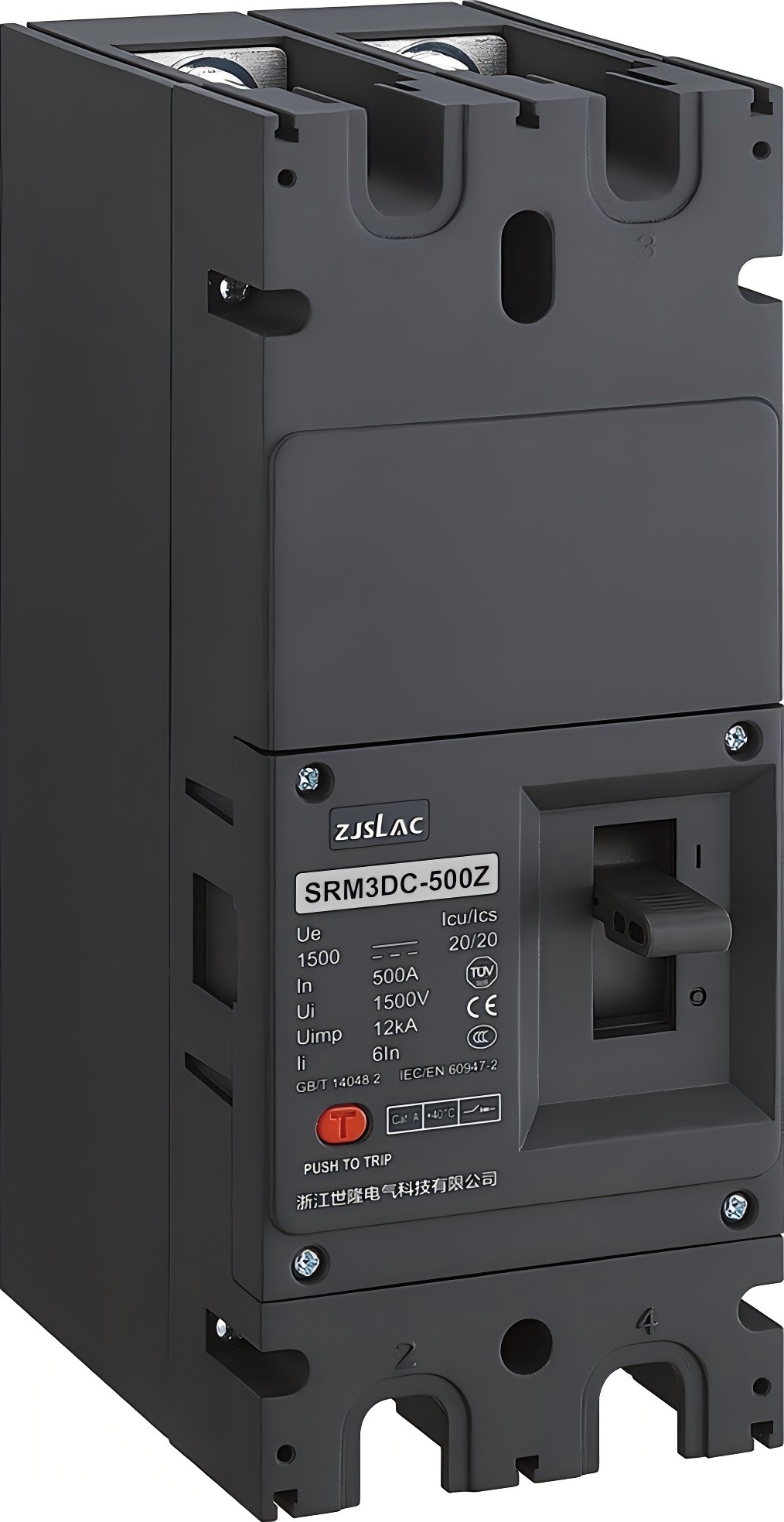
Voltage and DC Capabilities: MCCBs are engineered to handle higher operational voltages (up to 1000V AC / 1500V DC), making them critical for renewable energy and heavy industrial applications.
Standard Compliance: MCBs generally align with IEC 60898 (domestic/light commercial) or IEC 60947-2, while MCCBs strictly adhere to the more rigorous IEC 60947-2 or UL 489 standards for industrial applications.
Table of Contents
A Miniature Circuit Breaker (MCB) is a compact electromechanical device engineered to protect lower-voltage, lower-current circuits from overloads and short circuits. You will typically find these devices in final distribution boards, safeguarding individual branch circuits. They operate using a simple, highly reliable dual-mechanism system. A bimetallic strip bends under sustained overload conditions to provide thermal protection. An electromagnetic coil reacts instantly to massive current spikes to provide magnetic protection.
The defining characteristic of an MCB is its fixed-trip nature. The manufacturer pre-calibrates the tripping threshold, meaning field adjustments are impossible. This design keeps the unit compact and highly standardized. MCBs utilize a modular DIN-rail mounting system. Electricians snap them into distribution panels quickly, facilitating rapid installation and straightforward replacement. The internal arc chutes are relatively small, designed specifically to extinguish low-energy arcs generated by standard branch circuit faults.
A Molded Case Circuit Breaker (MCCB) serves as a heavy-duty protection device encased in a durable molded insulating material, typically a thermoset plastic or glass-polyester resin. This rugged housing provides exceptional dielectric strength and mechanical stability. It allows the breaker to safely interrupt massive fault currents without disintegrating. Engineers specify these devices for main power feeders, heavy machinery, and large commercial distribution boards.
Unlike their miniature counterparts, these breakers offer immense flexibility. Many units feature interchangeable trip units. You can upgrade or modify the protection parameters without replacing the entire breaker frame. They support advanced protection features, including adjustable overload settings, customizable short-circuit time delays, and integrated ground-fault sensing. This adaptability makes them indispensable for complex electrical networks requiring precise coordination. The internal components include massive copper contacts and extensive arc extinguishing chambers designed to stretch, cool, and dissipate high-energy plasma.
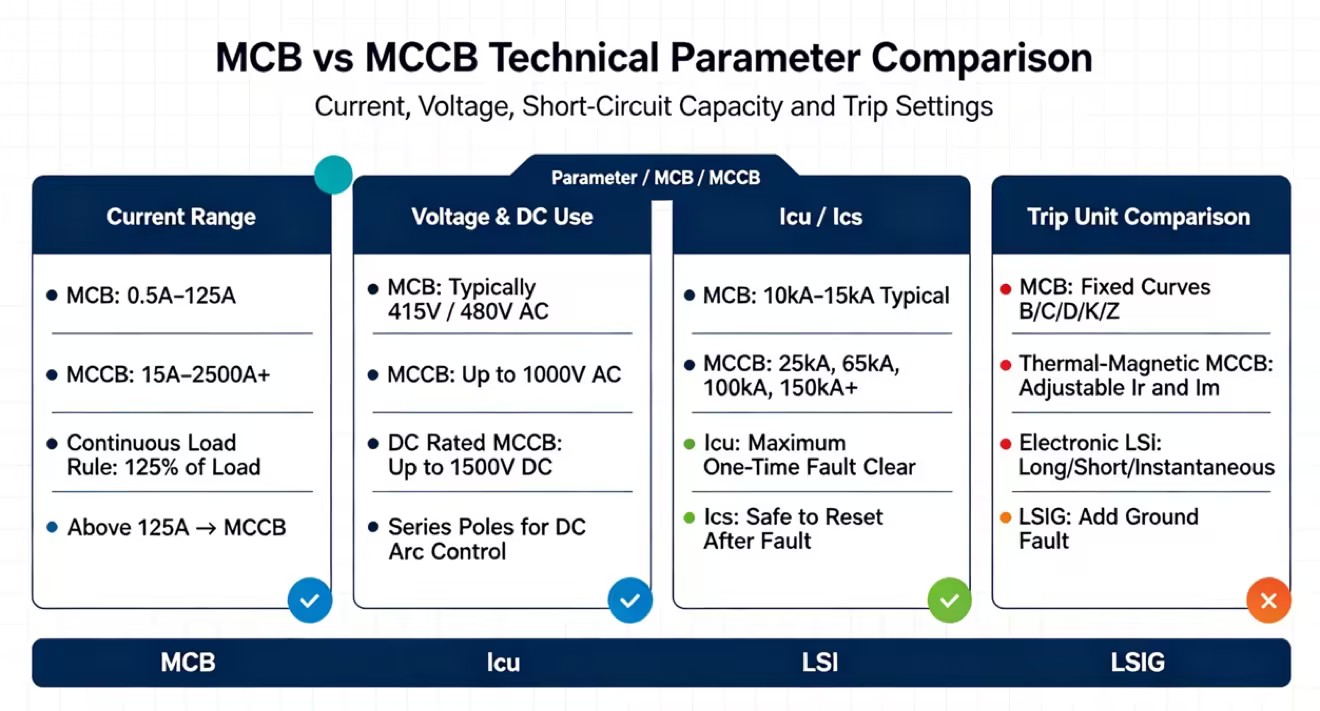
The most immediate differentiator between these two devices is their operational current range. MCBs are strictly low-current devices. Standard frame sizes range from 0.5A up to 125A. This makes them perfectly suited for lighting circuits, standard wall receptacles, and small single-phase motors. Molded case breakers cover a massive spectrum, starting around 15A and scaling up to 2500A or more. They bridge the gap between branch circuit protection and massive air circuit breakers used in main switchgear.
Continuous load calculations dictate the baseline requirement for either device. Electrical codes generally require breakers to be sized at 125% of the continuous load. If your calculated continuous load for a sub-panel is 150A, an MCB is immediately disqualified. You must specify a larger molded case device. Accurate load profiling prevents nuisance tripping and ensures the internal contacts do not overheat during normal operation. High-amperage loads generate significant heat at the terminal connections, requiring the larger lug sizes and superior thermal dissipation capabilities found in molded case frames.
Specification | Miniature Circuit Breaker (MCB) | Molded Case Circuit Breaker (MCCB) |
|---|---|---|
Continuous Current (In) | 0.5A to 125A | 15A to 2500A+ |
Frame Sizes Available | Standardized DIN profile | Multiple frame sizes (100A, 250A, 400A, 800A, etc.) |
Terminal Lug Capacity | Up to 50mm² (1/0 AWG) | Up to multiple 500 kcmil conductors per phase |
Thermal Dissipation | Low to Moderate | High (Engineered for heavy continuous loads) |
Voltage requirements are an important factor when selecting circuit breakers. MCBs are commonly used for lower-voltage AC systems, while MCCBs support higher voltage applications and larger industrial networks. For DC systems such as solar power, battery storage, and EV charging, specialized DC-rated breakers are required because DC arcs are harder to interrupt safely.
Short-circuit capacity determines how much fault current a breaker can safely interrupt. MCBs are suitable for low fault-current environments, while MCCBs provide much higher breaking capacity for industrial applications. Selecting the correct breaker requires calculating the available fault current to ensure safe operation during electrical faults.
MCBs use fixed trip curves such as B, C, and D types, making them suitable for standard loads with predictable current characteristics. MCCBs provide adjustable trip settings that allow engineers to control overload and short-circuit protection. This flexibility helps improve system coordination and protects complex industrial equipment more accurately.
Trip Unit Type | Adjustability Features | Best Application |
|---|---|---|
Fixed Thermal-Magnetic (MCB) | None. Factory calibrated to specific curves (B, C, D). | Lighting, receptacles, small static loads. |
Adjustable Thermal-Magnetic | Adjustable thermal dial (Ir) and magnetic dial (Im). | Standard industrial feeders, basic motor protection. |
Electronic (LSI) | Precise digital settings for Long-time, Short-time, and Instantaneous pickup/delay. | Main switchboards, complex coordination schemes. |
Electronic with Ground Fault (LSIG) | Adds adjustable ground fault pickup and delay settings. | Critical infrastructure, data centers, hospital mains. |
The number of poles depends on the power system and application requirements. MCBs are available in 1P, 2P, 3P, and 4P versions for residential and light commercial circuits. MCCBs are mainly used in 3P and 4P configurations for industrial power systems, large motors, and heavy equipment. The correct pole selection ensures proper isolation and safe circuit protection.
MCBs feature a compact DIN-rail design, making them ideal for applications where panel space is limited. MCCBs require larger installation space and stronger panel mounting due to their higher current capacity and larger cables. Proper clearance is also necessary to safely handle heat and arc energy during fault conditions.
MCBs are suitable for residential buildings, commercial branch circuits, lighting systems, small appliances, and low-power equipment. They provide simple and reliable protection where the load is stable and the short-circuit level is relatively low. Their compact DIN-rail design also makes installation and replacement quick and convenient.
MCCBs are designed for higher-power applications such as main feeders, industrial machines, large HVAC systems, and commercial power distribution. They offer higher current ratings, stronger fault protection, and adjustable trip settings. MCCBs are also ideal for systems that require advanced coordination, remote monitoring, or integration with building management systems.
MCBs are designed for basic circuit protection and occasional operation. Frequent switching can wear their internal mechanisms and contacts. MCCBs use stronger housings, larger components, and durable contact materials, allowing them to handle higher loads and more mechanical operations. They are suitable for main power systems and demanding industrial applications.
MCBs are usually replaced directly when they fail because they are sealed and factory-calibrated. MCCBs require regular inspection and testing to ensure reliable protection. Maintenance may include trip testing, contact checks, and insulation tests, especially for high-current systems where failure could cause major downtime.
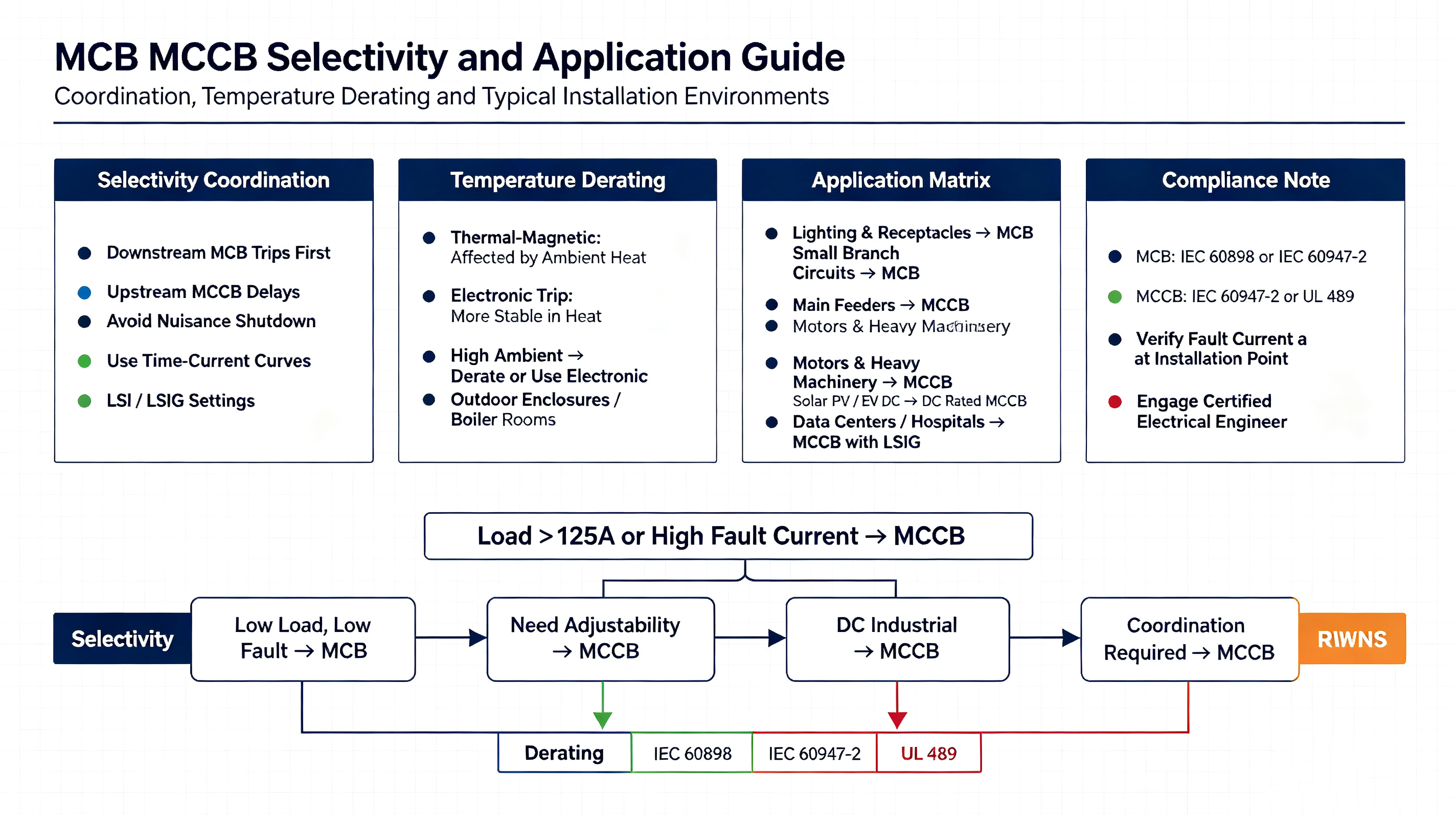
Proper coordination prevents unnecessary power outages. When a fault occurs, the breaker closest to the problem should trip first, while upstream breakers remain active. Adjustable trip settings and time delays in MCCBs help create this protection sequence. This allows the system to isolate faults quickly while keeping the rest of the facility running.
Circuit breakers can be affected by surrounding temperature. Traditional thermal-magnetic breakers may trip too early in hot environments because heat changes the bimetal strip response. For extreme conditions, electronic trip units provide more stable protection by measuring current directly and reducing temperature-related errors.
Modern electrical systems often require remote monitoring and control. MCBs provide basic status functions, while MCCBs support advanced accessories such as shunt trips, undervoltage releases, and motor operators. These features allow remote operation, emergency shutdown, and integration with smart building systems.
Choosing the correct standard ensures electrical safety and reliable operation. MCBs are commonly used in residential and light commercial applications following standards such as IEC 60898. Industrial systems require stronger protection devices that meet standards like IEC 60947-2 or UL 489 for higher fault levels and demanding environments.
The choice between these two protective devices is dictated by hard engineering constraints. Continuous load requirements, prospective fault currents, environmental conditions, and the need for system coordination form the technical boundaries of your selection. Understanding these parameters ensures your electrical distribution system remains safe, reliable, and code-compliant.
When shortlisting devices, apply a strict logic tree. Default to miniature breakers for final branch circuits under 125A with low fault levels (under 10kA) where fixed trip curves provide adequate protection. Escalate to molded case breakers for main feeders, loads exceeding 125A, high fault current zones, high-voltage/DC applications, or when precise trip adjustability and remote operation are required.
To move forward with your project specification, execute the following steps:
Consult the facility single-line diagram to map out all upstream and downstream protection devices.
Calculate the exact prospective short-circuit current at the specific panel installation point to determine the required Icu rating.
Evaluate the ambient temperature of the installation environment to decide between thermal-magnetic or electronic trip units.
Run a formal selectivity study using coordination software to ensure downstream devices trip before upstream mains.
Engage with a certified electrical engineer to finalize the breaker specifications and verify code compliance.
A: While technically possible if panel space and mounting hardware allow, it is usually unnecessary. You should only make this upgrade if the circuit's continuous load has increased beyond 125A or if the prospective fault current at the panel has increased beyond the miniature breaker's safe interrupting rating.
A: Standard miniature breakers typically max out at 63A, 100A, or 125A, depending on the specific manufacturer and product line. If your continuous load calculation exceeds 125A, you must transition to a molded case frame to ensure safe and compliant operation.
A: Standard AC breakers cannot safely interrupt DC arcs. While specialized DC-rated miniature breakers exist for small residential solar arrays, high-capacity utility solar PV and battery storage systems require specifically engineered DC-rated molded case breakers capable of handling up to 1500V DC.
A: Yes. Molded case breakers, especially high-amperage models with electronic trip units, require periodic primary or secondary injection testing and mechanical exercising to ensure reliability. Miniature breakers are generally considered maintenance-free and are simply replaced upon failure.
A: Thermal-magnetic units use a physical bimetallic strip and electromagnetic coil to sense overloads and short circuits. Electronic units use current transformers and microprocessors for highly precise current sensing. Electronic units offer extensive adjustability and are immune to ambient temperature fluctuations.
A: If the calculated fault current at the panel exceeds 10kA to 15kA, a miniature breaker will likely fail to clear the fault safely, potentially causing an explosion or fire. This mandates the use of a molded case breaker with a higher Icu rating to safely interrupt the massive current.


